



Sump Pump Installation & Replacement in Lawrence: Built for River-Season Water
If you are searching for Sump Pump Installation & Replacement in Lawrence, you already know the sound: a pump that runs nonstop after a spring storm, or worse, a sump basin that sits full and silent while water creeps across the basement floor. Lawrence sits on the Kansas River and Wakarusa River floodplain, where silty clay loam over limestone and shale bedrock holds water and swells as it wets. That means hydrostatic pressure builds against basement walls fast, and the sump pump is the last line of defense. We install new sump pits and replace failed pumps with properly sized units, sealed basins, check valves, and discharge routing that handles heavy spring rain and river-season storms without burning out. If your pump is cycling, tripping the breaker, or the basin is dry while the floor is wet, call (785) 371-2644 and we will inspect the system before the next storm front rolls in. Start with a free basement inspection so we can see what the pump is actually fighting.
Why Sump Pump Failure Hits Lawrence Basements Harder Than Most
Lawrence has a basement stock that punishes weak pumps. Old West Lawrence, Pinckney, and Oread hold 1870s to 1910s limestone and frame houses with stone foundation walls and full basements dug under the original footprint. East Lawrence and Downtown carry 1900s to 1920s bungalows with partly finished basements and old clay footing drains that clog and collapse. Central and north-side 1940s to 1960s brick ranches and split-levels sit on block lower levels, and the 1990s to 2020s subdivisions south and west of town, plus Eudora and Baldwin City, run poured full basements that collect water fast when the clay cannot drain. The dominant failure mode here is not a pump that wears out quietly. It is a pump that is undersized or unsealed and gets overwhelmed by heavy spring runoff and a rising water table during river season.
- An undersized pump cannot keep up with flash runoff off the uplands during a spring storm cell.
- An unsealed basin lets silt and gravel into the pit, which jams the float and burns the motor.
- A missing or failed check valve lets water drain back into the basin after every cycle, so the pump restarts all night.
- A discharge line that dumps too close to the foundation sends the same water right back into the footing drain.
- An old clay footing drain that has collapsed feeds the pit unevenly, so the pump short-cycles and quits early.
Each of those problems is correctable, and fixing them together is what makes a sump system last through a Kansas spring instead of one storm.
Key info: In the 1940s to 1960s brick ranches off North Lawrence and the central grid, we routinely find a 1/3 HP pump in a bare gravel pit with no liner and a discharge hose laid across the floor. That setup fails in the first heavy rain of April. A sealed basin and a 1/2 HP pump with a check valve change the outcome entirely.
For the city's own rules on drainage and discharge connections, check the City of Lawrence building and development pages before you schedule work, since local requirements vary and must be verified with the building department.
How We Install or Replace a Sump Pump in Lawrence
We work from the water source outward, not from the box the pump came in. The first step is finding out how water reaches the basin: through the footing drain, through wall seepage, or straight up through the floor slab under hydrostatic pressure. That answer decides the pump size, the basin depth, and whether the discharge can legally tie into the sanitary line or has to daylight to grade. We set the pit, seal it, plumb the discharge, and test the system with water before we leave.
- We inspect the basement, the existing pit, and the discharge route, and we check the footing drain for collapse or silt.
- We size the pump to the actual inflow, typically 1/3 to 1/2 HP for a residential basin, and select a cast-iron or stainless unit for longevity.
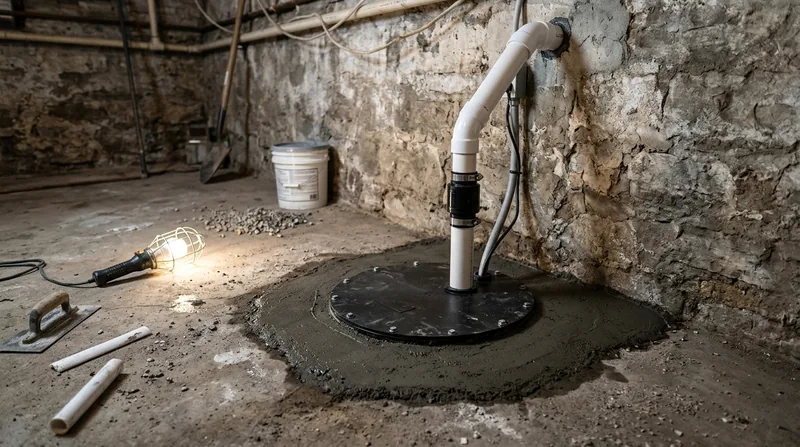
- We cut and set a sealed sump basin with a gasketed lid so silt, gravel, and basement air stay out of the pit.
- We install a check valve on the vertical discharge and route the line to daylight or a approved tie-in, kept clear of the foundation.
- We wire the pump to a dedicated circuit with a GFCI, and we add a battery backup if the homeowner wants protection during outages.
- We fill the basin and cycle the pump several times to confirm the float travel, the check valve seal, and the discharge flow.
When the pump is right but the water still arrives too fast, the answer is usually an interior drain tile system that intercepts water at the wall base before it reaches the floor.
Key info: A 1920s bungalow in East Lawrence had a pump that ran every 90 seconds in dry weather. The check valve was shot and the discharge line was buried two feet from the wall, so the same gallon was cycling. We replaced the valve, extended the discharge to the alley grade, and the pump went back to running only after rain.
Sump Pump Approaches We Use in Lawrence
Not every basement needs the same hardware. A poured full basement in a south Lawrence subdivision and a stone-walled cellar in Old West Lawrence handle water differently, and the table below shows how we match the approach to the building stock.
| Approach | Description | Best for |
|---|---|---|
| Primary pump replacement | Swap the failed unit for a correctly sized cast-iron or stainless pump, reuse or upgrade the basin and check valve. | A working pit with a burned-out or short-cycling pump. |
| New sealed sump basin | Cut and set a lined basin with a gasketed lid, sized to the inflow and tied to the footing drain. | Bare gravel pits in older Lawrence homes with silt problems. |
| Discharge line correction | Reroute the line to daylight or an approved tie-in, add a check valve, and keep the outlet clear of the foundation. | Pumps that recycle water or freeze at the outlet in winter. |
| Battery backup addition | Add a DC backup pump and charger to the same basin so the system runs through a power outage. | Homes that lose power during spring and summer storms. |
| High-water alarm and float upgrade | Install a vertical float switch and an alarm that sounds before the basin overflows. | Finished basements where a silent failure is costly. |
We pick the approach after the inspection, not before, because the water path tells us what the pump actually has to do.
Sump Pump Installation & Replacement Cost in Lawrence: What to Expect
Most residential sump pump replacements in Lawrence start around From $1,200 and move up from there based on the basin, the discharge route, and the electrical work. A straight swap in an existing sealed pit with a sound check valve sits at the low end. A new basin cut into a 1920s East Lawrence floor, a discharge line that has to be trenched to grade, or a dedicated circuit that has to be pulled all add labor and material. Stone foundation walls in Old West Lawrence can also mean more prep before the pit goes in.
The factors that move the number most are basin condition, discharge distance and routing, pump capacity and material, and whether a backup unit or alarm is added. Access matters too: a basement with a narrow stone stair and a low header takes longer to work in than a poured basement with a straight run. We give you the breakdown in writing so you can see what each line covers. Getting two or three estimates is smart, and it is the fastest way to tell whether a quote is pricing the pump or pricing the problem. Our full pricing overview shows the ranges we work from.
Choosing a Sump Pump Contractor Near Me in Lawrence: What to Check
Hiring for below-grade work near Lawrence means checking the same few things every time, and none of them are negotiable. Ask for the license and insurance certificate, not just a verbal yes. Ask how many sump systems the crew has installed in Douglas County basements, and ask for two references you can call. Confirm who pulls the permit if the discharge ties into the sanitary line or the work alters drainage, because the City of Lawrence building department sets those thresholds and they vary by jurisdiction. If you live under an HOA in a south or west Lawrence subdivision, check the association rules on discharge outlet placement before the work starts.
- Verify the contractor is licensed and insured, and ask for the certificate by email.
- Get two or three written estimates that itemize the pump, basin, valve, and labor separately.
- Ask for local references from basements similar to yours, not just newer builds.
- Confirm who handles the permit and the inspection, and get that in the scope.
- Check HOA and city rules on where the discharge can outlet before the line is run.
When you are ready to talk through your basement, reach out through our contact page and we will set a time to look at the pit and the water path.
If you are in the 66045 area near campus or just across the river, the Lawrence 66045 service page covers the same work for that part of town.
Sump Pump Installation & Replacement in Lawrence: Pricing Guide
| Service | Price | Details |
|---|---|---|
| Primary sump pump replacement | Starting at $1,200 | Includes a correctly sized cast-iron pump, check valve, and labor in an existing sound basin. |
| New sealed sump basin and pump | Starting at $1,850 | Covers cutting and setting a lined basin with gasketed lid, pump, and discharge plumbing. |
| Discharge line correction and reroute | Starting at $650 | Reroutes the outlet to daylight or an approved tie-in and adds a check valve where missing. |
| Battery backup pump addition | Starting at $900 | Adds a DC backup pump and charger to the same basin for power-outage coverage. |
| Complex or large-scale job | On estimate | Stone foundation walls, long trench runs, or combined drain tile work need an on-site look first. |
| Estimate | Free | Response within 24h at (785) 371-2644, no obligation to book the work. |
Indicative pricing, the exact cost depends on square footage, finish, and site access. Free personalized estimate within 24h at (785) 371-2644.


